
Advance care directive
Decide for yourself who acts for you.
With an advance care directive (Vorsorgeauftrag), you determine who looks after your personal and financial affairs and represents you in legal matters if you lose capacity of judgement (Art. 360 ZGB). We advise you on its content and notarise the directive.
The advance care directive must either be written by hand from beginning to end, dated and signed, or be publicly notarised (Art. 361 ZGB). A text typed on a computer and merely signed is not sufficient. Public notarisation is particularly suitable for extensive arrangements, for estates that include real estate or businesses, and where writing by hand is difficult.
Without an advance care directive, spouses and registered partners have only a limited statutory right of representation (Art. 374 ZGB). Otherwise, the adult protection authority (KESB) orders the necessary measures and determines who acts for you.
What the advance care directive covers
You can entrust personal care, the management of assets and representation in legal matters to one or more persons. The tasks must be described; you may give instructions and name substitutes in case the appointed person does not accept the mandate or later terminates it (Art. 360 ZGB). It is also sensible to regulate remuneration (Art. 366 ZGB). Medical instructions belong in a patient decree; it does not require notarisation.
It takes effect only once the KESB has examined it
If you lose capacity of judgement, the adult protection authority examines whether the directive was validly executed, whether the conditions have been met and whether the appointed person is suitable. If that person accepts the mandate, they receive a document setting out their powers (Art. 363 ZGB). So that the directive can be found, you can have the place of deposit recorded by the civil register office (Art. 361 para. 3 ZGB). As long as you have capacity of judgement, you may revoke or amend it at any time (Art. 362 ZGB).
Our procedure
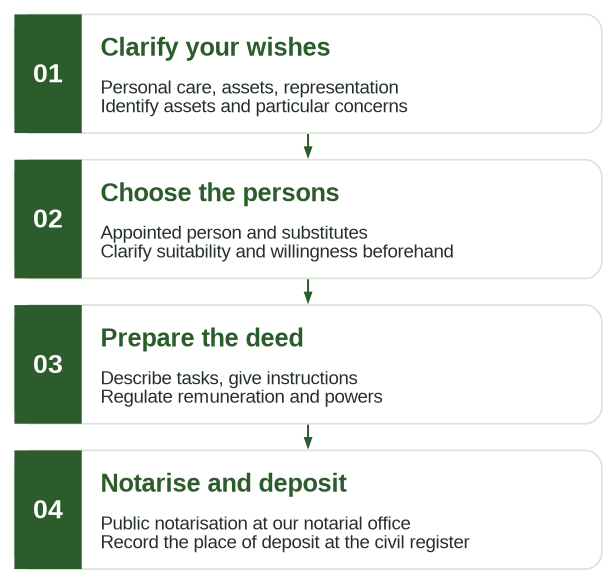
- Clarify your wishes: Identify tasks, assets and personal concerns.
- Choose the persons: Select the appointed person and substitutes.
- Prepare the deed: Define instructions, remuneration and powers.
- Notarise and deposit: Comply with the form and register the place of deposit.
Arrive well prepared
Have a valid identity document, the personal details of the persons you intend to appoint and an overview of assets, real estate and any businesses ready. You must have capacity of judgement at the time of notarisation; if there are doubts, a medical certificate may be advisable.
Request a notarial appointmentAdditional information
More about the advance care directiveFrequently asked questions about notarisation
Find practical guidance for your situation, grouped by notarial service. The specific requirements depend on your transaction; we clarify documents, attendance and costs with you before the appointment.
For personal precautionary planning
Does an advance care directive have to be publicly notarised?
No. It is also valid if you write it by hand from beginning to end, date it and sign it (Art. 361 ZGB). Public notarisation is advisable for longer texts, where real estate or businesses are involved and where doubts about form or capacity of judgement are to be avoided.
Whom can I appoint?
One or more natural or legal persons, for example relatives, trusted persons or a professional (Art. 360 ZGB). You can divide the tasks and name substitutes. The adult protection authority later examines whether the person is suitable for the tasks (Art. 363 ZGB).
From when may the appointed person act?
Only once you have lost capacity of judgement and the adult protection authority has examined the directive and declared it effective. It issues the appointed person with a document setting out their powers (Art. 363 ZGB). For the time before that, a power of attorney is needed if required.