
Company formation and start-ups

From your idea to your own company
We assist with forming your AG or GmbH in Switzerland through legal advice and notarial support. Together, we clarify legal form, equity interests and organisation and prepare the steps leading to commercial registration.
-

Company formation
We support the formation of your business in Switzerland — from legal assessments to preparing the necessary incorporation documents. Together, we review legal form, authorisation requirements and relevant organisational steps. We also include VAT registration and insurance questions in formation planning.
Further information -

Shareholders’ agreement
When forming a business together, a shareholders’ agreement establishes clear rules for cooperation, participation and subsequent exit. We help founders agree voting rights, equity transfers and dispute resolution arrangements suited to the company and Swiss law.
Further information -

Explain your options
Choosing between an AG, GmbH and sole proprietorship affects liability, financing and organisation when establishing a business in Switzerland. We explain the legal options and assess legal form, location and contractual structure with you, providing a clear basis for your decision.
Further information -

Intellectual property (IP) protection
Trademarks, technical developments and other intangible assets can be commercially decisive for start-ups. We advise on protecting intellectual property and assess which protection rights, registrations and contractual provisions are appropriate for your idea and business model.
Further information -

Contracts — from NDAs to licensing agreements
We draft and review contracts for start-ups and young businesses — from NDAs and licensing agreements to arrangements with suppliers, employees and freelancers. We tailor drafting to your business model and intended cooperation.
Clear provisions on services, payment, usage rights and confidentiality help reduce later interpretation issues. Particularly for website, software or product development, we assess who owns the results and which rights your company may actually exercise.
Further information
How company formation works
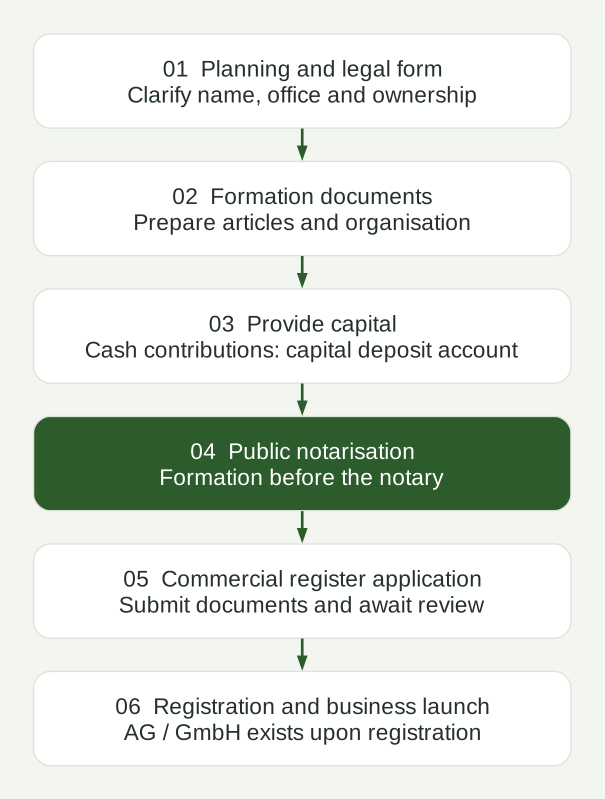
A sound company formation begins before signing. We tailor preparation and notarisation to your plans and assist with the commercial register application.
- Planning: Clarify the legal form, company name, registered office and equity interests.
- Documents: Prepare articles of association and organisation.
- Capital: Organise contributions; for cash contributions, establish a capital deposit account.
- Notarisation: Have the incorporation deed publicly notarised.
- Application: Submit documents to the commercial register.
- Registration: The AG or GmbH comes into existence upon registration in the commercial register; operational registrations and setup steps follow.
Simplified procedure for AG and GmbH formations. Contributions in kind, special authorisations or other formation circumstances may require additional steps.
Company formation from CHF 2'000.00
We provide personal support in preparing and notarising your company formation. We agree the specific scope of services and costs with you before you instruct us.
More than a signature: legal advice and notarial services together
An official notarial office can notarise the formal incorporation deed. Our added value lies in combining legal advice with notarial support: we discuss your objectives, review tailored provisions and consider how the articles of association, equity interests and contracts interact. AI systems may provide initial information but replace neither personal legal assessment nor the required public notarisation. With us, you have direct contacts — from your first questions to implementing your company formation.
A free initial consultation for your legal concerns
We offer new clients a free, non-binding 15-minute initial consultation. You tell us about your concerns, and we discuss your situation and possible strategies. We are here to support you through legal advice or representation in proceedings. We look forward to meeting you.
Complex questions from practice
Who is liable for start-up contracts entered into before commercial registration?
Individuals acting for the business may incur personal obligations. Subsequent assumption by the company requires the statutory conditions to be met. Each pre-incorporation contract should clearly document the party, its connection with formation and timely assumption.
Before registration, every agreement should identify the current contracting party and the intended subsequent assumption. Keep a list of these obligations and review the assumption process after formation. Merely using the future company name does not reliably protect those acting from personal liability.
How can a decision-making deadlock between two founders each holding 50 per cent be avoided?
Statutory authority, articles of association and the shareholders’ agreement must be coordinated. Deadlock procedures, mediation and exit mechanisms require clear triggers and fair valuation. A blanket casting-vote clause is not valid in every governance structure.
Agree which decisions trigger a deadlock and what steps follow. A staged solution involving discussion, mediation and a clearly regulated exit may be more manageable than an immediate forced sale. Valuation and financing must fit the founders’ situation so that the mechanism is commercially workable.
Which legal and financial risks should be examined in a convertible loan before the next financing round?
Conversion conditions, valuation, interest, maturity and ranking are decisive. A subsequent share issue also requires the corporate-law steps. A contractual promise of conversion replaces neither capital resolutions nor assessment of a financial crisis.
An overview of triggers helps distinguish maturity, conversion and possible repayment. Also examine what happens if the expected financing round does not occur. The effects on ownership and liquidity should be calculated clearly before a convertible loan is signed.
How can founders secure rights to inventions and software developed alongside their previous employment?
The employment contract, activities, resources and statutory rights to work products must be examined. Transferring them to a start-up does not automatically extinguish third-party claims. Clarify chains of title before investor discussions and public product presentations.
Document development time, resources used and the people involved. Rights of a previous employer or third parties may be important for financing and subsequent commercialisation. Clear written allocation and any necessary consent should be established before contributing the work to the start-up.