
Certification of signatures and copies
Personal advice. Careful preparation.
Certification confirms a particular fact — such as the authenticity of a signature or that a copy corresponds to the original. We clarify which confirmation is needed for your purpose.
We certify signatures and confirm that copies correspond to the originals presented. For signature certification, you must attend in person with valid official identification; for copy certification, we need the original document.
Certification confirms the authenticity of a signature or that a copy matches the original, rather than providing a general confirmation of the document’s legal validity or substantive accuracy. For use abroad, we discuss any additional requirements imposed by the receiving institution.
Confirm signatures in person
For signature certification, you attend in person with valid official identification. We clarify in advance whether you will sign before the notarial officer or personally acknowledge an existing signature. When signing for a company, evidence of authority to represent it may also be required.
Copies and use abroad
For copy certification, the original must be presented. A purely digital image does not automatically replace the original. For documents intended for foreign institutions, their requirements should be clarified before the appointment. Any necessary apostille or legalisation is issued by the competent cantonal chancellery, not by our private notarial practice.
Our procedure
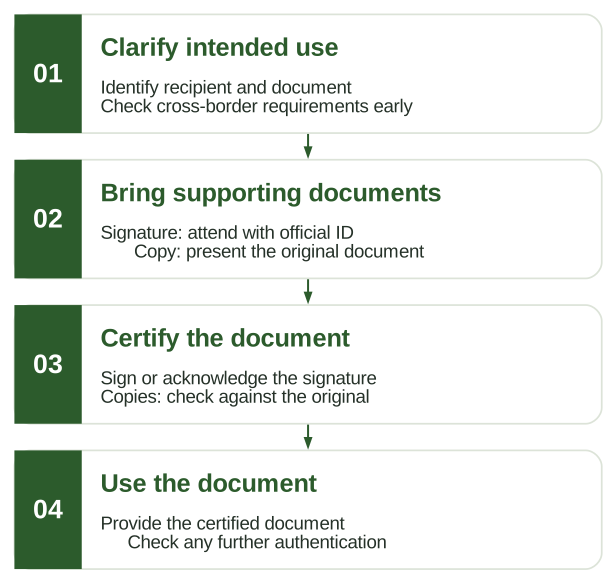
- Intended use: Clarify the receiving institution’s requirements.
- Identification or original: Verify identity or the original document.
- Certification: Officially certify the signature or copy.
- Further requirements: For use abroad, clarify further authentication separately.
Arrive well prepared
Bring your valid official identification and the document to be certified or its original. Tell us its intended use and, for use abroad, the receiving institution. If in doubt, wait until the appointment to sign, once the procedure has been agreed.
Request a notarial appointmentFrequently asked questions about notarisation
Find practical guidance for your situation, grouped by notarial service. The specific requirements depend on your transaction; we clarify documents, attendance and costs with you before the appointment.
For documents submitted to authorities or used abroad
What is the difference between notarisation and certification?
Notarisation records a legal transaction or declaration through the prescribed legal procedure. Signature certification instead confirms the authenticity of a signature; copy certification confirms that a copy matches the original presented. It does not generally confirm the document’s contents or legal validity.
Can a signature or copy be certified by email?
For signature certification, you attend in person with valid official identification. We clarify in advance whether you sign at the appointment or acknowledge an existing signature. For copy certification, we need the original document; an emailed scan does not automatically replace it.
Do I also need an apostille for a document used abroad?
This depends on the destination country, receiving authority and document. Check their requirements before the appointment where possible, including language or translation requirements. Any required apostille or legalisation is obtained from the competent public authority; our private notarial practice does not issue this further authentication.