
Wills and public testamentary dispositions
Personal advice. Careful preparation.
Your last will should be recorded clearly and in the required form. We advise on the appropriate form of will and assist with preparing a public testamentary disposition.
We help you draft and review your last will. For a public will, the notarial officer prepares the document in accordance with statutory requirements and with the participation of two witnesses.
A handwritten will is a different statutory form and does not additionally require notarisation. We explain the differences, assess the appropriate arrangements and discuss safe storage that allows the will to be found. Official opening of wills is not part of our private notarial services.
Express your last wishes clearly
We discuss the appointment of heirs, legacies and other permissible instructions in light of your family and financial situation. Compulsory shares, existing inheritance agreements and earlier wills must be considered. Clear wording helps avoid contradictory instructions and unnecessary questions of interpretation.
Choose the appropriate statutory form
A handwritten will must generally be written entirely by hand, dated and signed. A merely typed and signed text does not satisfy this form. A public testamentary disposition is executed by the notarial officer in the statutory procedure with the participation of two witnesses. We explain the differences and the requirements in your particular case.
Our procedure
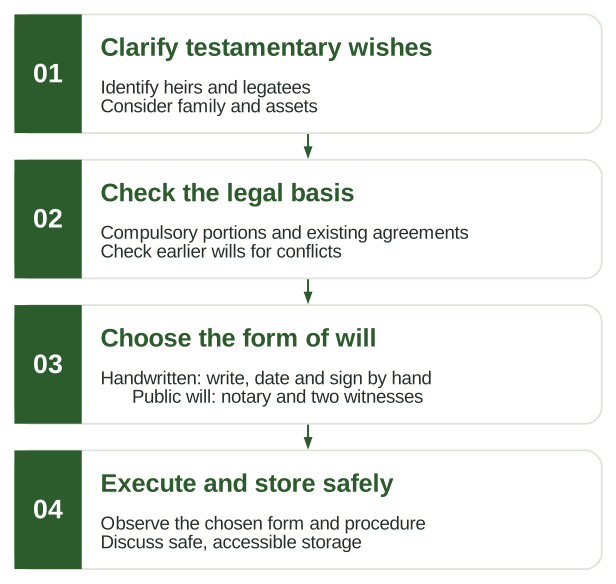
- Clarify your wishes: Identify family, assets and beneficiaries.
- Determine the form: Consider a handwritten or public will.
- Prepare the disposition: Clarify its content, compulsory shares and existing commitments.
- Execute and store: Comply with the required form and discuss safe, accessible storage.
Arrive well prepared
Have existing testamentary dispositions and inheritance agreements ready, together with details of relatives, intended beneficiaries and significant assets. For public execution, we coordinate identification, personal attendance and suitable witnesses in advance.
Request a notarial appointmentAdditional information
More about willsFrequently asked questions about notarisation
Find practical guidance for your situation, grouped by notarial service. The specific requirements depend on your transaction; we clarify documents, attendance and costs with you before the appointment.
For people wishing to make a will
Does my will have to be notarised?
No. A handwritten will is a statutory alternative: it generally must be entirely handwritten, dated and signed. A merely typed and signed document does not satisfy that form. For a public will, the notary prepares the disposition with the participation of two witnesses. We advise you on the appropriate form.
What should I consider before an appointment for a public will?
Consider whom you want to appoint as heirs or benefit through a legacy. Bring earlier wills, existing inheritance agreements and details of your family and significant assets. We review compulsory shares and contractual commitments and arrange your personal attendance and two eligible witnesses in advance.
Where should I keep my will, and who opens it after my death?
Your will should be stored securely and be accessible after your death. We discuss suitable storage or deposit arrangements and how to handle earlier versions. In the canton of St. Gallen, the official opening of a will is the responsibility of the competent public authority, not part of our private notarial services.